
Gary Smith is treading outside of economics territory and measuring Life, but he hasn’t quite crossed the boundary yet. He’s showing how log vs linear graphing can aid or obscure your understanding of a topic. It’s a hugely important point, and deeply familiar in acoustics and speech and neurology.
His first attempt made a linear graph of sample size vs ‘accuracy’ of generative AI. Some commenters pointed out that the line would quickly exceed 100% accuracy, so he revised to a tanh or log form, which is how LIFE works.

Grow quickly, encounter obstacles and feedback, rise more slowly until the driving force matches the feedback. Reach maturity. Maintain maturity until the driving force starts to weaken or the obstacles get stronger.
= = = = =
Does this match ‘accuracy’? Not really.
Generative AI in the visual realm steals massive numbers of images and applies a moving lens to small parts, then asks how often other lenses are found on each side of the central lens. The result is created by filling in the most common lenses on each side of each central lens.
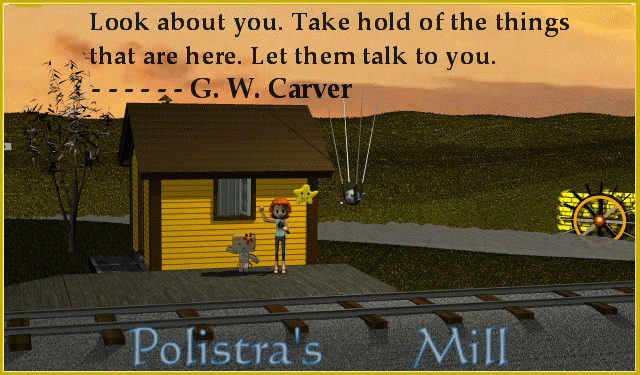
Start with Polistra and friends as seen above:

When the lens steals grass,

What’s to the right?
What’s to the left?
When the lens steals a house corner,

What’s to the right?

What’s to the left?
When the lens steals part of Polistra’s face,

What’s to the right?
What’s to the left?

When the lens steals a railroad track,

What’s to the right?
What’s to the left?
The algo also correlates verbal descriptions of images, which are available most of the time, thanks to Web Standards developed many years ago to make AI’s theft easier. Innocent humans have also been roped into the descriptive act with those fiendish Recaptcha things, which uncoincidentally resemble the lenses I was using.
This process is why AI tends to over-duplicate things like fingers and wheels and windows. The data set doesn’t say where and why a sequence has to stop. Life always has a stopping point, whether it’s the genome for hands or the blueprint for a house or the torque limits on axles and driveshafts. The stopping points are NOT obvious from a visual inspection of the object. You have to know the PURPOSE.
In other words you have to know what the graph is approaching. The picture will never reach 100% agreement with reality, but it can asymptote better if it uses NEGATIVE FEEDBACK from real constraints.
The big problem with AI is that the real constraints are not available.
Real physical artists and even real digital “artists” always start with PURPOSE. When I “build” an old telegraph or an old house, I always know how the pieces connect, and I know the purpose of each part or room or wheel. I always animate the device and write a Python to simulate the overall purpose of communicating or transporting.
The PURPOSE shapes the result, even if it doesn’t agree with any existing 2d visual pattern.
Accuracy is a meaningful goal, but you can’t hope to measure it by the number of lenses. Accuracy requires a knowledge of the underlying PURPOSE, whether genomes or construction contracts or axle load regulations.
= = = = =
Every exponential in real life has an endpoint. Tanh does not have a fixed endpoint.
If you want an EXPlosion, use EXP. If you want a life or a business or a project to reach maturity, use tanh.
In electronics, diodes are quasi-exponential:

The driving force, like water entering a millrace, has to overtop a small barrier before it can start driving the mill:

Resistors are also quasi-exponential, but the barrier is so small that it doesn’t matter in practical use:

These curves are theoretical. There’s an endpoint when the breakover voltage or heat burns up the diode or resistor.
Real designers have to know the limits, which are often uncomfortably close to the operating range. The limits aren’t on the theoretical graph, but you WILL know when you hit them.
Every real thing, animate or inanimate, has limits that aren’t on the graph or picture. In finance, every exponential has a legally required or practically forced endpoint. Compound interest is never allowed to reach infinity. If you think it can, you WILL be burned.
And that brings us back to bonds bonds bonds bonds,
Bond, a loan, a fixed term loan,
Stock, a piece of golden fraud,
Meme, a name to squeeze a short,
Fear, a way to cause a run,
Short, a legal form of theft,
Law, a trader’s favorite buy,
Tears, a trader’s sweetest wine,
and that brings, etc.
= = = = =
Metanote: I could have come closer to the visual image with
Dough, my dear, my only dear,
Pay, what losers do for fun,
but my PURPOSE was to make the point about bonds.
 Polistra's Mill