
When FDR took office, he had to fix two parallel legacies of the booming speculative 20s, both of which caused busts in the 30s. There were cross-ties between the two legacies, so he couldn’t fix either one by itself. He had to fix them in a cross-linked way.
One boom was initiated by huge government purchases of food in WW1. Bankers encouraged inexperienced farmers to buy poor land to take advantage of the demand. When the demand quickly disappeared, the farmers were left with a mortgage and no way to pay it. They abandoned the farms after plowing off the (already poor) topsoil. When a fairly serious drought hit in 1930, the land took flight, covering up everything in its path.
Even competent farmers on good land had been using ineffective methods, allowing wind and water to carry off the soil. Millions of tons of topsoil were ending up in the Gulf of Mexico.
The other boom was the stock boom, which needs no introduction.
= = = = =
FDR’s administration used similar methods to solve both problems.
In the context of soil:
When the wind comes whistlin cross the plain, a line of trees can redistribute its energy. The air has to twist and turn between small leaves and branches. Part of the force is thus turned aside and spent in mechanically thrashing the leaves and branches, and part is spent in the whistlin.
And when water comes rushing across a sloped field, a dense planting of grass can redistribute its energy. The water has to twist and turn between the stems and flat blades. Water that stops for a moment in front of a grass blade has a chance to penetrate the soil. Without grass, the water moves freely and begins to pick up soil particles. As it gets more gritty, its scraping ability grows exponentially until it’s a muddy flood.
But you can’t leave everything planted to grass all the time if you’re trying to grow profitable crops. So you have to use two other methods. Crop rotation allows part of the farm to be in grass in any one season; and contour plowing insures that the plowed rows serve as mini-dams to force the water down instead of across.
What’s the common factor here? Angular momentum. Stopping a flow by using reactance instead of resistance. Breaking up massive linear motion into small circular and angular moves, so the air can feed the trees and the water can feed the plants.
= = = = =
In the context of economics:
Speculators are like the linear force of wind and water. They advertise a seemingly unstoppable linear expansion. Buy now! Prices are going straight up, and prices have to keep going up up up UP UP UP UP UP UP!!!! Join the flood while you still have a chance! Become part of a mudball that will help to gather other soil particles! Become a nail that can bounce against the side of a house and loosen up other nails to join the blast! Isn’t that attractive? FUN FUN FUN!
FDR redistributed the linear momentum of money into more useful angular momentum.
Glass-Steagall and bank reform provided a windbreak and a contour. Speculators were halted, forcing money to pause and thrash around in the same place. When money had to stay in the same place, it had a better chance of penetrating local soil and feeding local business. Bank reform allowed money to stay securely in the same place, decreasing the temptation to join big floods.
WPA was like a field of dense grass. Money stored in government clouds was rained onto real workers, who then produced real value and spent their money in local businesses. Real labor created real irrigation systems and real windbreaks and real dams, nicely closing the circle of my analogy.
= = = = = END REPRINT.
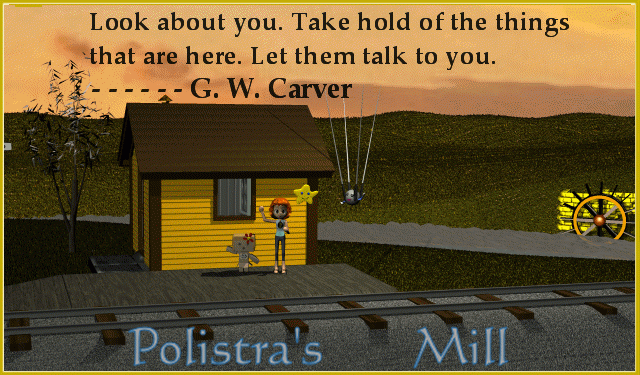
Now back to the Wincharger. First we set the scene. (I’m reusing my WPA teacherage for obvious reasons.)

We see a rural house with a pumphouse. The Wincharger, supervised by HappyStar, is mounted on the pumphouse so it can power the water pump first of all, then some lights and appliances in the house secondarily.
Here’s the Wincharger itself:

Most of the mechanism is self-evident. A weathervane rotates the whole setup to face the wind. A propeller turns a generator directly. A brake lever applies a brake shoe inside the brake drum. The governor is the two weights at right angles to the propeller. Wincharger supplied a ‘stub tower’, suitable for mounting on a pumphouse or grain bin, but most often it would be extended with a taller tower built on site.
At first I thought the governor weights would slide outward to slow down the prop by angular momentum, using the classic skater’s arms principle. Perhaps they were connected to the brake, as in the classic spinning pawn shop governor? The detailed pics by restorers didn’t answer the question.
The original Albers patent answers the question.
A further object of our invention is to provide a governor having features for utilizing the governing action by natural forces with a minimum number of movable parts. A pair of centrifugally urged flaps are adapted to present their broadened surfaces in the line of travel of the propellers so as to cause a turbulent effect wherein centrifugally urged wind or air forces will be located in the path of travel of the propeller blades, thereby disrupting the normal wind forces striking the propeller, causing a loss of efficiency in the rotating blades.
The weights are not weights at all. They’re like the flaps on aircraft wings. They confuse part of the straight-line flow before each blade of the propeller enters this part of the flow.
The Albers governor worked just like a windbreak.
Here’s a straight wind encountering leaves. The air currents get tangled and twisted in an infinite number of small vortices (blue). The energy is still there; it hasn’t been converted to heat or anything else; but now it’s confused and incapable of breaking walls or lifting topsoil. Real windbreaks were much denser than my simplified pair of trees. The CCC planted windbreaks all over the Plains, often using the tough and flexible Osage Orange or bois d’arc tree.

The flaps moved like this. I’ve shown the prop rotating slightly counterclockwise to clarify that the flaps were gathering air after each blade passes, creating a slight vacuum and turbulence before the next blade enters the flow.

At lower prop speeds the flaps remained in their default position, held by the retractor springs. They didn’t disturb the wind flow through the blades.

At higher prop speeds the flaps gradually pulled open, cupping forward and leaving a partial vacuum behind. They created a turbulent area for the next prop blade, breaking up the available linear force.

= = = = =
Finally, if you wanted to hold the prop still for bad wind, or to service the mechanism, you could set the brake. Here the pictures are unclear. The brake lever has a hole for a rod or wire, and the wire is meant to run down through the center pivot. One of the ads shows a rod down through the tower with a weight on the end, but this would only serve as a demo. You’d need a parking brake, not a foot brake. I’ve imagined a lever as part of the control panel.
The control panel is also poorly pictured, but it definitely included an ammeter and possibly a voltmeter, and switches to disconnect the generator and house circuits. It also included an automatic cut-in relay for the lower end of the wind speed scale. Like a car’s voltage regulator, this relay only connected the generator to the batteries (through a resistance) when the gen voltage was above the batt voltage. Otherwise the batteries would run the generator like a motor, using up all the charge without any purpose.

Here’s the whole setup in action. Wincharger on top, a bank of wet cells below, control panel in between. Polistra is pulling up on the brake once in each revolution, pulling the rod down and applying the brake shoe inside the brake drum.
= = = = =
 Polistra's Mill