
Thinking about Wincharger and rural electricity, it occurred to me that phones were common on farms LONG before electricity and automobiles and mail service. Started looking through old sources, easily verified the proportion:
The rural free delivery carrier’s route rarely exceeds 24 miles in length and serves on an average about 70 farms. A rural telephone will operate as far as 40 miles, with as many as 30 or 40 telephones on the line. Of course in the well-settled States the farmers have both, but in the vast sections of open country it is obvious that it will be some time before rural free delivery can reach as many farms as the rural telephone.
While looking, ran across a more interesting set of facts.
In the city, party lines were just annoying. You typically shared the line with one or two neighbors, who were not necessarily part of your social circle.
In the country, party lines were a tech implementation of existing social circles. The loop typically had 20 to 40 phones, each with its own ringer code.
This 1906 handbook was issued by Swedish-American Telephone Co in Chicago, with a branch in KC. It’s aimed at rural coops who wanted to add phone service. Pretty much everything you’d need to know before buying and hiring. How to set up the coop organization, how to hire and pay linemen and operators, how to plant poles and string wires, how to connect phones, how to operate a switchboard and keep peace among the parties. Needless to say, the handbook recommended buying your equipment from Swedish.
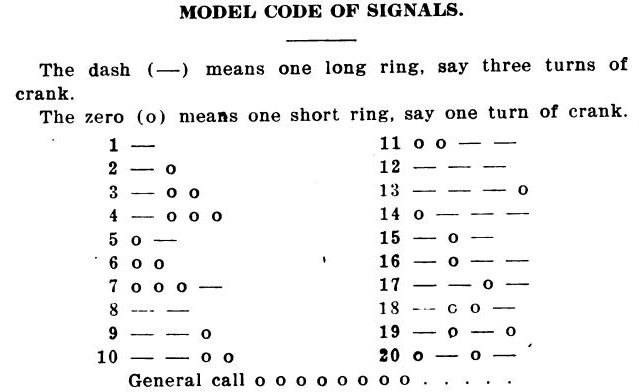
Here’s the suggested ringer codes:
Transcribing:
The dash means one long ring, say three turns of the crank. The zero means one short ring, say one turn of crank.
1 –
2 – o
3 – o o
4 – o o o
5 o –
6 o o –
7 o o o –
8 – –
9 – – o
10 – – o o
11 o o – –
12 – – –
13 – – – o
14 o – – –
15 – o –
16 – o – –
17 – – o –
18 – o o –
19 – o – o
20 o – o –
Timing a code by crank turns is a familiar idea. The 3:1 ratio is the same as Morse, and the signals are distinctly Morsy. Most are standard letters, a few are offbeat letters like German umlauts.
Here’s a four-line party circuit:

The important point about a party line is that each farmer could ring any of the others in the loop without involving the central exchange. You assumed that everyone could be listening, you assumed that everyone knew all the codes, and you assumed that Mabel was listening. Anonymity is meaningless in a small town. No chance to troll. Mabel only got involved if you needed to call a foreign number outside your circle.
In modern terms, every call was a conference call. If you wanted to discuss sharing expenses for a harvest crew with Hanson and Swenson, you’d crank up Hanson’s code and Swenson’s code and wait for both to answer.
And the handbook closes with a guarantee that was meaningful to farmers and coops in 1906:

Followed by a ‘parting note’ that is worth reprinting verbatim.
In concluding this book, the publishers feel they would be remiss in ordinary courtesy did they not express in some manner their keen appreciation of the splendid patronage accorded them in the past. The confidence and compliments that have been bestowed upon them in recent years have inspired them to their highest efforts, month by month. It has been, and shall ever continue to be, the motto of this house to issue nothing but the best.
Particularly is this true of the equipment we are now turning out for country lines. We realize full well that rural companies cannot afford to keep high-priced electricians to look after their lines, nor is such an expense necessary when Swedish-American phones are used. Our immense plant in Chicago employs only the most modern methods of manufacture known. Located, as we are, in a field like Chicago, we are enabled to select our skilled mechanics, specialists and experts from a vast array of the finest talent in the world. Labor of this kind may cost a trifle more than it does in small towns but it proves vastly more satisfactory in the end. Skilled workmen, operating our specially designed and almost automatic machines, turn out the finished product in well nigh faultless style. And, after it has been thoroughly tested, as it invariably is before leaving the factory, there is little left that could be desired.
And so we say in giving you this book, that if you want to make home cheerful and happy, if you want to “please the women folks” and keep the boys with you on the farm, get together and decide upon a telephone line to town. You’ll never regret the day the step was taken, and if you purchased the right kind of phones, you’ll learn, like so many others scattered over this smiling land of ours, to esteem and respect:
THE SWEDISH-AMERICAN TELEPHONE CO.
 Polistra's Mill