
I’ve been putting together some digital replicas of TVA’s model city at Norris, obviously not trying to include the whole thing! Here’s the top view of the street plan with a scattering of houses.

The original was somewhat denser, but nowhere near ‘walkable’. Norris was named for Senator George Norris, who had been pushing the idea for many years. He was also a friend of rural electrification and coops, stating that “cooperation is my religion.”
= = = = = = START QUOTE:
Norris was conceived as a model of progressive town planning for the region. Surveys and designs were begun in August 1933, and the town was occupied in the spring of 1935. Norris’s first residents were indeed the workers who built the dam, who rented directly from the TVA, but even after construction ended applications for housing remained steady. Inhabitants included the operators and managers of the Norris Dam, employees of the other TVA divisions, and non-TVA employee families. In 1948 the town was sold in a public auction, and many long-time residents quickly bought their homes.
= = = = = END QUOTE.
From surveys to occupied in two years. Now it wouldn’t happen at all. Environmental and Indigenous and Diversity obstacles would pile up instantly and use up all the appropriated money.
Norris was NOT designed to be walkable because in the 30s walkable meant places like this. The planners wanted to create a spacious suburban atmosphere for their permanent workers and engineers.
They also built a barracks-style dorm for the temporary CCC/WPA workers who weren’t going to stay and raise families.
The town hall included a grocery store and post office:

Norris hasn’t changed much as seen on GoogleMaps. There are plenty of newer houses, but examples of the original types are still there. Here’s a House 41C.

The original 41C looked like this:

I didn’t make one of these because it was generally similar to the D2. I wanted to tribute the D2 for its dogtrot qualities. Like WPA, the TVA took great pains to uphold local culture and traditions. In those years private architects were Brutally SMASHING local culture and traditions.
D2 from a distance:

D2 closeup:
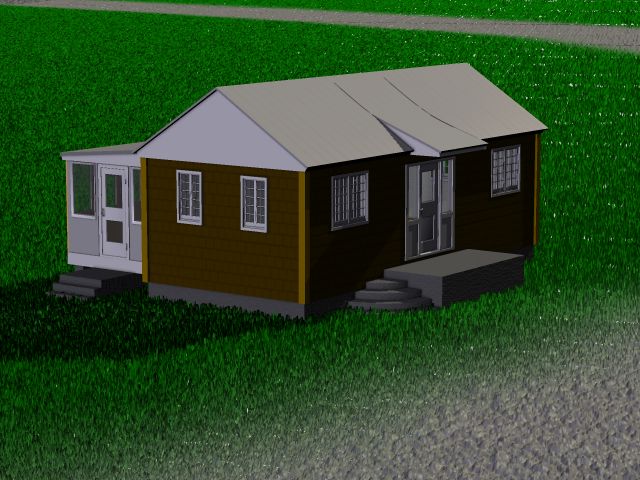
D2 floor plan:

Following the southern Dogtrot tradition, with a broad center hall and separate areas on either side, and a huge screened porch on the back.
House A anticipated the later Ranch type, which was rare in the ’30s.


Continued in Part 3.
 Polistra's Mill