

An experiment shows fungi don’t like silence. But the choice of sounds is peculiar.
= = = = = START QUOTE:
To investigate the impacts of sounds on fungi, Jake Robinson at Flinders University in Australia and his colleagues buried green and rooibos teabags in soil inside a soundproof box. Inside the box, they played an 8 kilohertz tone at a volume of 70 decibels for one group of teabags and 90 decibels for another, 8 hours per day for 14 days. A control group received only ambient sound stimulation of less than 30 dB.
At the end of the experiment, both sets of composting tea bags exposed to sound had increased in weight, from 2.5 grams to 3.1 grams on average, due to the growth of fungi. The control tea bags stayed the same weight on average.
= = = = = END QUOTE.
That’s a noticeable improvement but not dramatic.
= = = = = START QUOTE:
In a second experiment, the researchers played an 8 kHz tone at 80 dB to Petri dishes containing Trichoderma harzianum, a fungus that lives in soil and promotes plant growth. After five days, the samples exposed to sound had an average of 2.5 million spore cells per millilitre of culture fluid, while the control samples had just over 540,000.
= = = = = END QUOTE.
Now that’s impressive! Growth multiplied by 5.
The article doesn’t explain why they chose an 8k pure tone, though this paragraph might be a clue to their thinking:
= = = = = START QUOTE:
To facilitate acoustic stimulation, we downloaded (from YouTube) an 8-hour video playing a monotonous 8 kHz sound (Tinnitus Flosser Masker at 8 kHz). We tested the frequency using a Wildlife Acoustics Echometer Touch Pro bat detector, designed to capture high-frequency acoustic signals.
= = = = = END QUOTE.
Steady 8K is not part of nature. Neither wind nor ground waves nor bugs nor birds produce a steady tone. Some chirps (bats, birds, crickets) are in that range, but they’re not steady.
The researchers theorize that the sound simply keeps the cell walls moving, helping osmosis. Could be, but seems to underrate the intelligence of the fungi. Complex plants hear in pretty much the same way that animals do, with rhythm and pattern detectors. The mechanisms are different but the result is the same.
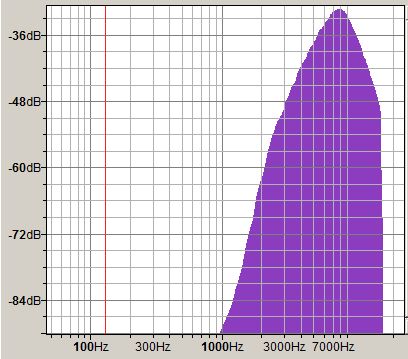
= = = = =The Youtube channel describes the sound as narrowband noise with 8k emphasized. I can’t hear it because it’s above my elderly threshold. The 2k versions from the channel’s sampler sound to me like an Okie summer evening with crickets everywhere, so maybe the choice makes sense after all.
Here’s a spectrum of the 8k version from Audacity:
 Polistra's Mill