

Briggs is trying to bring real human experience back into science. In this piece he analyzes claims of telekinesis and speculates on quantum action. He doesn’t reach any conclusions. I think he may be starting from an unproductive angle.
Our thinking on these subjects is narrowed down by our intuitive sense that force is a positive PUSH acting on an object.
Life emphatically doesn’t agree. Life mostly moves things by changing impedance on two sides of a balance.
Nature moves water around by changing the impedance of the ground.
We had 3/4″ of rain yesterday from two separate storms. A gravel street in the neighborhood always gathers a huge puddle after a rain. The puddle stays for several days.
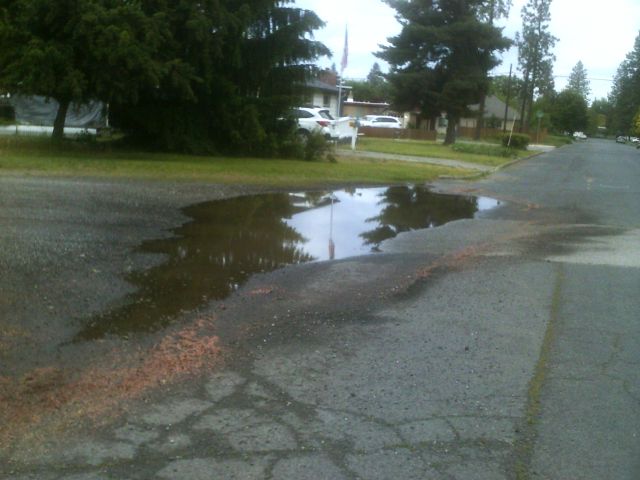
For comparison, here’s my “driveway”, which is just grass. It’s a similar low spot next to pavement. No puddle, and the pavement is dry.

Intuitively the gravel street should absorb water because there’s no cement under it. But it doesn’t absorb at all. Impedance, not force, is the key. Grass eagerly absorbs water. When water soaks down an inch deep, the roots pull it in immediately, making room for more soak from above. Where grass isn’t making room, the water soaks down an inch and stays there. All the available spaces are filled and incompressible. Nothing is actively emptying them.
= = = = =
Constants and Variables:
In 2016 I snapped the newly built Pit in the boulevard. The Pit was raw dirt at that time, and the picture was taken after two storms totaling 3/4″.

I snapped the same pit today, after the same type of input. The pit now has well-established grass and trees, both joyously lapping up the water.

Incidentally, this plant has taken over the non-pit parts of the median. I don’t recall noticing it before. The leaves are bright silver, not obvious in my terrible photo. Googling its description leads to variegated sage.

= = = = =
Soil conservation is all about managing impedance. The New Deal taught farmers how to use impedance to move water by contour plowing, and to move air by windbreaks. Windbreaks are an even more sophisticated use of impedance, altering the balance with reactance instead of resistance.
When the wind comes whistlin cross the plain, a line of trees can redistribute its energy. The air has to twist and turn between small leaves and branches. Part of the force is thus turned aside and spent in mechanically thrashing the leaves and branches, and part is spent in the whistlin.
Here a simplified windbreak is sheltering a farmhouse.

Seen from above, a straight wind encounters the windbreak. The air currents get tangled and twisted in an infinite number of small vortices (blue). The energy is still there; it hasn’t been converted to heat or anything else; but now it’s confused and incapable of breaking walls or lifting topsoil.

Real windbreaks were much denser than my simplified pair of trees. The CCC planted windbreaks all over the Plains, often using the tough and flexible Osage Orange or bois d’arc tree.
= = = = =
A universally familiar example of moving by impedance is breathing. When we want air, we don’t insert a pump into the nose and push air inward. We expand the lungs, making more room between the molecules inside, and the outside air flows in to equalize the impedance.
In the other direction, the larynx is a windbreak. It transforms the steady outward movement of an exhale (which IS a push) into vortexes that decrease the outward velocity. Try speaking a sentence with lots of sibilants, or just sing the Lawyer’s Song: Sue sue sue sue sue! Hold your hand in front of your mouth and you’ll detect the difference in force between the windbreaked voice and the unpulsed sibilants.
Complex mechanical and electrical systems move fluids by decreasing the pressure on one side. When you open a faucet, the water in the pipe senses the lower pressure on the air side and flows to equalize the balance. When a transistor opens its gate, electrons flow through to the opposite side which has been intentionally deprived of electrons.
= = = = =
Now back to speculating on telekinesis.
The interplanetary magnetic field is shaped by the motions and magnetic pulls of all the planets. For the sake of modeling, I’ve drawn the magnetic field as a surface below the planets. Venus has a positive pull and Mars has a negative pull. This corresponds to one Kepler-derived scheme of planetary influence, attributing raininess to Venus and dryness to Mars.
When Venus and Mars are in opposition across Earth, a sharp gradient is formed:

The gradient moves charge across Earth like water from gravel to grass.
When Venus and Mars are more distant and off-angle, there’s no particular gradient around earth, so no particular influence:

This field does a good job of modeling the influences found by Kepler and his followers through experiment and observation.
What’s the mechanism? The interplanetary field shapes long-term weather patterns in two ways, one definite and the other speculative.
1. Definite: The field directly moves and shapes our semi-liquid iron core, which moves heat into different areas of the globe. The icecaps are melting FROM BELOW, not from above. The Gulf Stream is being redirected FROM BELOW, not by the atmosphere.
2. Speculative: Bacteria and other plankton are magnet-driven. They navigate by the declination of the field, riding a declination line up or down. When the declination lines change, as they are doing now, bacteria move in different ways, redistributing shade and photosynthesis and nutrition in the ocean. Think Nino/Nina.
The magnetic field shapes human behavior in two ways, both speculative.
1. Our cerebellum has an antenna for electromagnetic fields. We don’t do a lot of navigating, but we respond in unknown ways to changes in the planet-scale field. When it’s stronger, we may be more synchronized and harmonious. When it’s weaker, we have less guidance. As now.
2. Bacteria again. Our digestion is performed by bacteria, which are presumably responsive to magnetic fields like the ocean bacteria. When the field weakens or strengthens, they will behave accordingly. Right now the earth’s field is weaker, which means the bacteria are confused and sluggish. See Obesity.
The universe’s electromagnetic field is incompressible on average like an ocean. The more familiar forces in the field are pushes. A solar eruption pukes a huge tsunami of charged particles in one direction, shoving aside the charges in the ocean. When the tsunami encounters movable areas like our internal magnetic sensors or our telephones and radios, it can swamp out our normal variations.
When there’s no tsunami, small variations are instantly filled.
Speculation: If our nervous system can create a suction zone by absorbing or vortexing some of the field, there will be a local movement in the field, just like the local movement in the atmosphere when we inhale or the movement of water toward grass. This local movement, if strong enough or multiplied by several people acting together, could cause detectable external changes.
 Polistra's Mill