

I noticed this strange tube in the same 1897 book where I found some weird Magic Lantern displays.

This isn’t for a Magic Lantern; it belongs to the world of early X-ray work. When I saw the diagram it first reminded me of a mercury-vapor fullwave rectifier.

It also reminded me of the mercury-vapor Vreeland oscillator:

The latter turns out to be much closer. In fact this was a variant of the Crookes x-ray tube, designed to be driven by an induction coil. After reading the description, I see it’s a fullwave reflectifier, not a fullwave rectifier!
First the Crookes tube, where X-rays were discovered by accident.

The Crookes tube contains a partial vacuum, sparse air molecules. It forms an ion beam from the remaining air molecules. The electrons passing between the two electrodes are not the usable beam. The electrons are traveling rightward from the negative cathode to the positive anode. A chain reaction, like lightning, strips out POSITIVE ions from the air atoms. The positive ions head leftward toward the negative cathode, accelerating as they go.** Because they’re more massive than plain electrons, they have enough momentum to reflect off the negative cathode and bounce toward the glass. When they hit the glass, they stir up the glass atoms, which emit X-rays. Experimenters tried various coatings on the glass to achieve fluorescence, presaging the CRT tube.
Here’s why the reflectifier was wanted.
The best source of high voltage back then was the secondary of an induction coil, which is AC instead of DC. When the current reverses, the ions flow the other way, into the cup-shaped anode. What happens there isn’t clearly specified; most likely the positive ions eat up the outgoing electrons and cancel the flow instead of bouncing out onto the glass. Half the time is spent building the ion cloud, and half the time dissipating it.

= = = = =
The reflectifier has two anodes, wired in parallel to one side of the induction coil. The single reflecting cathode then serves to reflect BOTH WAYS.
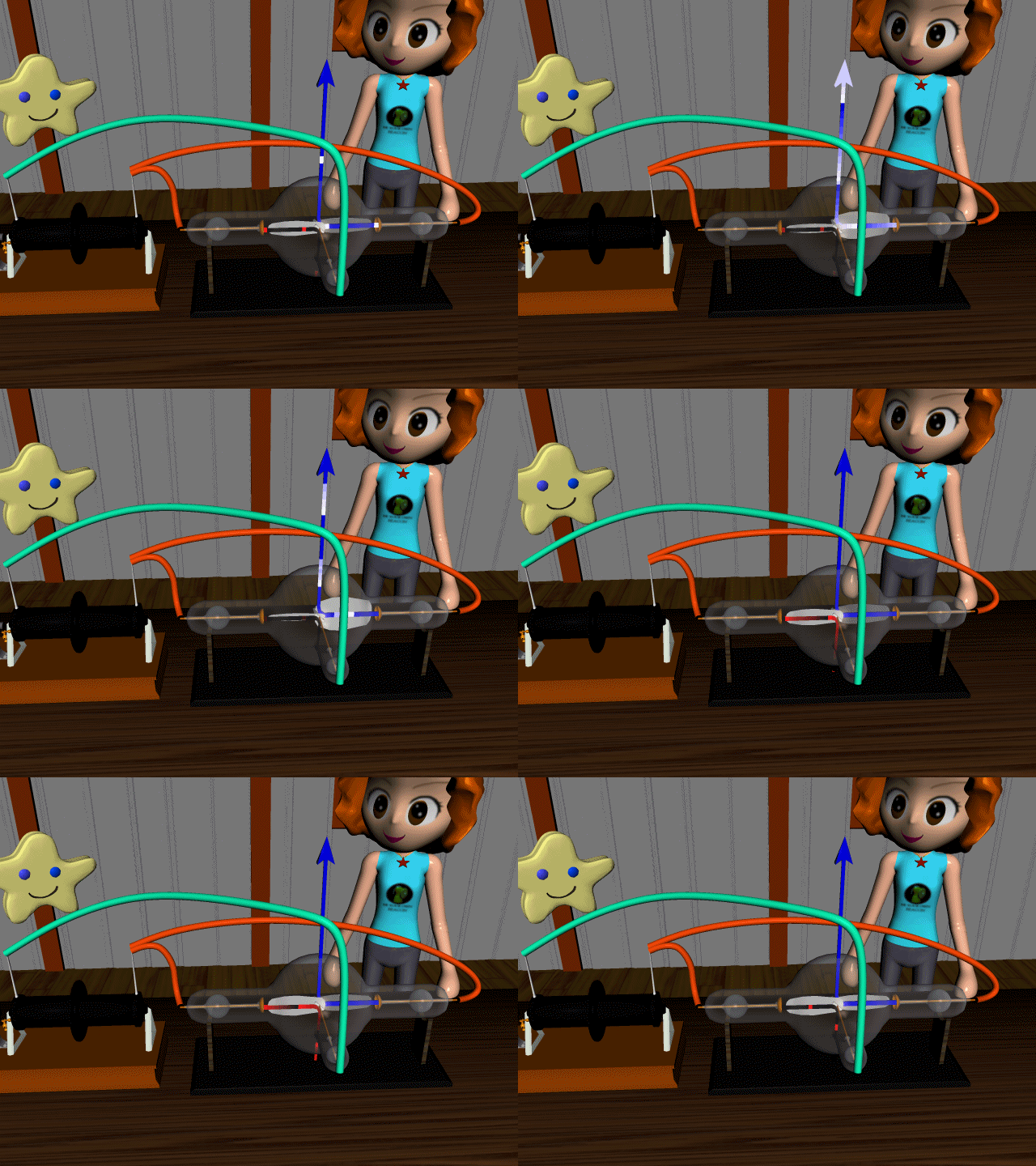
Each side can then maintain its ion cloud without dissipating on the alternate stroke. In this version the lower output stream is intentionally wasted into the lead base, and the upper stream is used. Another version makes both outputs available.
= = = = =
** This contrary action is similar to what happens in an electroplating vat, as seen in my series on Electrotyping.
 Polistra's Mill