

Before Fessenden developed underground and underwater sonar equipment, he went to work for an early radiotelegraph company. There he developed a unique system of private broadcasting, steganography for radio, the audio equivalent of invisible ink. Privacy was felt to be needed because radio had lost the innate self-contained privacy of a telegraph wire.
Most of this system was soon obsolete, as vacuum tubes made precise tuning easier on both ends.
Before tubes, spark gaps created a broadband hissing. Tubes made it possible to form a clean and stable sine wave, enabling each station to have its own single narrow frequency.
Before tubes, receivers couldn’t be very selective. Without the isolating effect of an amplifier, the entire receiver was one resonator. With isolation, radios could have several stages of tuning like the stages of a tournament or job search, with each stage acting independently and selecting from the range provided by the previous stage. The first stage narrowed down the signal by a certain percentage. The second stage picked up this result and narrowed down again by a certain percentage, then the third stage selected a certain percent from the already selected second stage.
In theory you could pick only .01% of the available frequencies with one resonator, but you’d also end up with .01% of the intensity, so there wouldn’t be anything left to drive the earphones. Each stage of amplification restored the intensity of the narrowed frequency, so the next stage could start fresh on intensity.
= = = = =
Fessenden’s Secrecy Sender was a frequency-shift keyer. When the key was down the transmitter raised its broadband frequency slightly, 1/4 of one percent. A receiver in that era couldn’t separate such a small change, so an ‘unlicensed’ listener would simply hear a steady hiss with no changes at all. The ‘licensed’ listener with Fessenden’s receiver would hear dots and dashes, though not as sharply as the binary on and off of a normal radio telegraph. Testers found that fast sending was impossible and repeats were often necessary.
= = = = =
Here we see Fessenden’s experimental shack on Machrahanish Island near Nova Scotia. His unique antenna was a hollow cylinder, claimed to be better tuned than a wire or mast.

Here’s the Secrecy Sender with Polistra at the key.

And the duplex receiver, with Polistra tuning one of the capacitors and Happystar listening.

= = = = =

The transmitter was a typical spark-gap set with one modification. A battery runs a buzzer to provide AC for the primary of the induction coil, and the spark gap adds broadband high frequency to the high-voltage secondary. The coil’s resonance favors one frequency range among the broad hiss.
Normally the key would also be in the primary loop, interrupting the buzzed AC for dots and dashes. In this arrangement the key only changes the resonance of the induction coil slightly**.
The primary is tapped, and the key shorts out a small part of the primary. This decreases the inductance slightly, thus favoring a slightly higher broad band of frequencies.

= = = = =
The receiver is definitely unique and clever. Instead of the usual single resonator, it has a bridge-like pair of tuned circuits. The signal from antenna first goes through the reel-inductor, then branches into the two sides of the bridge. The right side is tuned slightly higher than the left.

Both sides are broad, because broadness was unavoidable before tubes. The right side is tuned slightly higher than the left. When the transmitted signal is at its slightly higher broad band, the right side has a slightly higher voltage across the secondary of the coil. It acts opposite to the left side, decreasing the result slightly. The result then goes to the electrolytic detector where it’s demodulated. The battery and potentiometer bias the detector so it acts something like an amplifier.
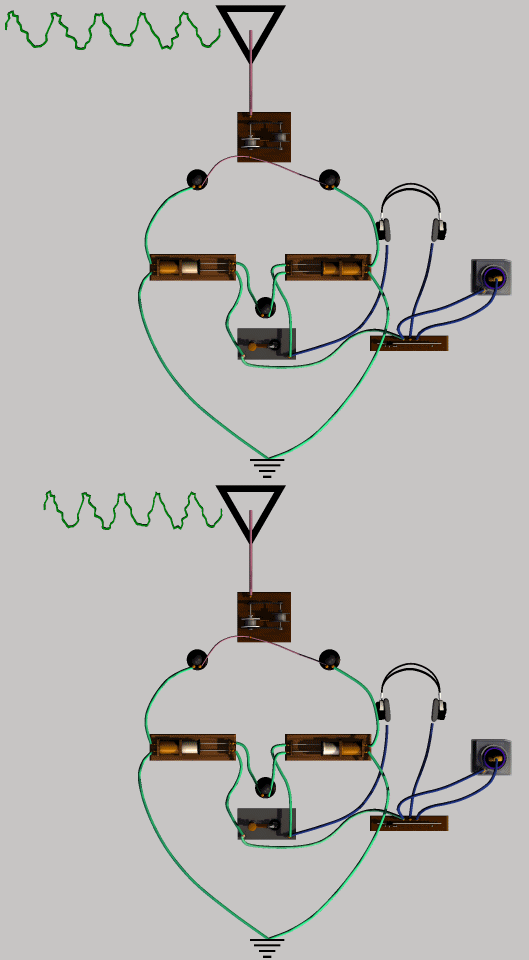
The reel-inductor and electrolytic detector aren’t really necessary for the bridge trick. Any inductor and any detector would serve. Both were Fessenden’s unique inventions, so he included them in his unique bridge. He was clearly having fun!
The reel-inductor was a clever way of achieving a finely variable inductance, more delicate than the usual sliding tap which only acted at intervals of one turn. The wire was uninsulated. The left reel was a conductor, so the left side was effectively connected to the circuit at the exact point where the wire departed from this reel. The right side was insulated, and was the actual inductor. The length of wire on the inductor was thus continuously variable.

The electrolytic detector wasn’t quite as unique. Lodge and others used similar devices to set up a microscopic barrier between two conductors. This one achieved the semiconductor effect by dropping a fine platinum wire into a nitric acid solution. The wire caused electrolysis in the acid, forming an ionized layer that preferred conduction in only one direction.

= = = = =
** Footnote: Fessenden’s actual method was somewhat different. He added an extra primary around the coil, and energized the extra primary from the key. This must have changed the resonance slightly, but I’m not sure how it would have worked, so I chose a tapped primary instead, which is clearer from an electronic standpoint. Also, my induction coil is way too small. Fessenden specialized in high power broadcasting, so his induction coil was probably 6 feet tall. I needed to fit everything on a table as a semi-schematic model.
= = = = =
Graphics footnote: Books and patents have solid descriptions of these devices but no photos. There are clear photos of the shack and antenna, which I copied. The components are mainly from a 1915 Adams Morgan catalog. These were all designed for experimenters, with each part on its own base. The old equivalent of today’s plug-in breadboard setups. Most early wireless experimenters used similar breadboardish components, lashed together somewhat randomly, so it wouldn’t be surprising if Fessenden did things the same way.
= = = = =
Later fussy correction: The source I was using for the diagram of his lab scene was confused about the location, or else I was confused. In fact Machrihanish is not in Nova Scotia, it’s in Old Scotland. Fessenden’s site was on Brant Rock off Massachusetts. He achieved transatlantic communication between his lab on Brant Rock and Machrihanish in Scotland.
 Polistra's Mill