
In 1966 I was exploring the Manhattan area. Southwest of town I found a huge brick building with a nice porch, fronting a peaceful little lake. The building looked like a hotel. On a nearby corner was a little country general store. Checking maps, I found that the building was the Oddfellows nursing home, and the store served a rural community called Eureka Lake.
The retirement home has a short and long history. A 2017 PDF, written for a university history course, tells the whole story expertly with proper footnotes.
= = = = =
The short history:
In 1880 a fast-moving Chicago entrepreneur arrived in Manhattan. CP Dewey had big plans. His first move was Chicagoan. He bought a cattle ranch southeast of town and set up feedlots and a slaughterhouse. He moved into town where he started a livery stable, then bought and improved the new city electric plant.
In 1899 he found Eureka Lake, which was already named. It’s a typical elbow lake, left behind when a river shortcuts across a tight meander.
This 1890 map of the entire 6×6 township shows the elbowness nicely.

A closer view from an earlier map:

Note the Stagg property to the east. Stagg is still recognized in the Stagg Hill golf course and Stagg Hill Road, which carried US40 from Manhattan to Junction City before a wider highway was built. Note also the Union Pacific railroad, probably part of Dewey’s reason for choosing the property.
He bought land around the lake and started building a resort hotel, finished in 1902. The massive luxury hotel attracted rich visitors from KC and Chicago via the railroad. Continuing his earlier business, Dewey also set up a small ranch and slaughterhouse to provide fresh beef for the restaurant.
Dewey had rental boats and diving platforms to entertain the guests, and a fountain for visual beauty.

Note the cute names: SS Manhattan and SS Junction City. Bet there was also an SS Ogden.

His success was immediately halted by the 1903 flood which remodeled a large part of Kansas. The flood heavily damaged the buildings and filled in part of the lake.
This newer map shows how the lake and the river looked after the 1903 flood. The flood moved the river two miles south, and the partly filled lake is much smaller, pretty much as I remember it from 1966. Another Lost Place is in the same area, Cave Gas along Rosencutter Road.

= = = = =
The long history:
Dewey went back to Chicago and soon died. His son wasn’t interested in restarting the hotel, so he was happy to sell in 1906 when the IOOF offered to buy the property. Like other lodges, IOOF was a full-service Mutual Benefit Association, providing medical care and old-age care for members. At first it appears that they used the site for a wide range of activities, including youth training. One 1906 picture shows the “dedication of the juvenile building”. Later they tore down the huge hotel and used the smaller building as a retirement home, which was still active 60 years later when I saw it.
Here’s the smaller building soon after IOOF took it over. It looked about the same in 1966.

= = = = = = = = = =
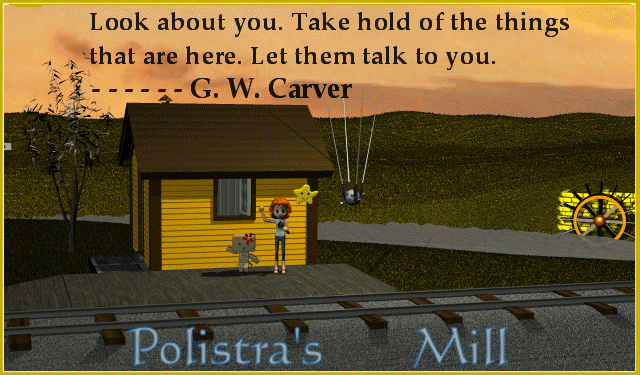
Eureka Lake restarts my Lost Places series after a long hiatus. The gatehouse satisfies my need to draw secure little shacks as refuges for the imagination.
I’ve drawn a mix of original and later parts. I included the later version of the lake and the IOOF home. I added the original fountain and gatehouse, and placed the corner store across the street. (In reality it was about a mile east of the lake.)
Polistra is approaching the gate of the resort.

Seen from inside, showing the grocery store and the back of the gatehouse.

Polistra tries out the cozy little gatehouse.

Rocking chairs were the icon of peaceful retirement, celebrated in songs and poems. Resorts for oldies had rockers on porches. Rockers seem to be out of fashion lately, perhaps because retirement is no longer peaceful. They were good for health, moving the innards gently and using leg muscles to help the heart.

Polistra rents a boat and rows out to watch the beautiful fountain.

= = = = =
Epilogue: The cattle ranch southeast of town ended up with the Poole family. I knew one of their daughters in high school. Years later the Pooles donated the ranch to the government, and it’s now the Konza Tall Prairie Reserve. The lake was later filled in, probably in 1992 when the Job Corps Center was built on the site, echoing the youth training functions of IOOF.
Happy Ending: After setting up all of this, I finally used Google Maps to look at the Flint Hills Job Corps Center. In fact the building isn’t lost at all! Both IOOF buildings are part of the Job Corps Center.

Happy Ending 2: Several IOOF retirement homes in Texas, California and Illnois are still operating as part of the IOOF. Fraternal Benefit Societies are NOT entirely obsolete!
= = = = =
Later footnote with some details not given by my original source. This is from a 1911 ‘Cyclopedia of Kansas’ under the heading of Odd Fellows. It gives the exact date and size of the IOOF home at Eureka Lake, along with the size and benefits of the state lodges.
= = = = = START QUOTE:
The grand lodge reports for 1911 showed 564 subordinate lodges in the state, with a membership of 49,264. When the first lodge was instituted it had but five members. During the five years from 1906 to 1910 the order has increased about one-third of its membership; has paid out in relief to members over $500,000 and the assets of the subordinate lodges have increased over $530,000.
On April 26, 1906, the Rebecca IOOF home at Manhattan was dedicated, with accommodations for 30 adults and 60 children.
= = = = = END QUOTE.
 Polistra's Mill