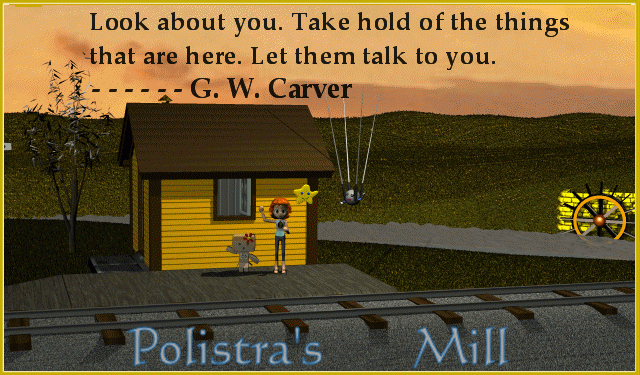

Vector fields are a math tool used in graphing and understanding sets of forces or complex patterns. Vector fields have proved useful with brain networks. Older forms of measurement were also vectorial, with complex measures like metes and bounds forming vector fields to measure farm fields.
A vector is an arrow representing a movement and a direction. The length of the arrow may be simply a length, or may represent a force or velocity or other quantity. A vector field is a pattern of arrows representing a pattern or field of lengths or forces.
Brain networks are formed by paths in the axons (white matter) inside the brain. Some appear to be permanent, others are momentary resonances for a purpose like linking grammatical parts of a sentence. The permanent connections are two-way paths, and the two paths are resonant with synchronous flows in both directions. The brain has a remarkable mechanism to form the paths, and another mechanism to maintain the resonance when one path is longer than the other, or when one path is altered by damage. Paths are laid down by glial cells, represented here by Happystar as an astrocyte.

The glial cells form and reshape myelin along a vector field of axons to wire up a path or change its speed and resonance. Like Hansel and Gretel, they leave a path that can be retraced. The entirety of glial paths is an infinitely complex and ever-changing vector field.
Amazingly, nerve action moves as fast as necessary to maintain resonance. Signals travel along axons at widely varying rates, constantly adjusted to keep the two ends of the path synced up with other paths that are involved in the same resonance. A balanced resonance is the goal.
Glial cells constantly monitor the signal paths along axons, modifying the myelin to slow or speed one path as needed. If one path changes, the glial cells go to work again to get the bounces along this path synchronized with the other paths involved in this thought. Each axon is a vector of constant time. When its length increases, its speed also increases to maintain the constant time interval.

= = = = =
What if land measurements had been purely polar instead of partly rectangular? An aerial map of western Kansas shows a polar pattern created by circle irrigators. I discussed the irrigators here.

Each irrigator is a physical vector, sweeping out a vector field of watered and green wheat. If you didn’t know about irrigators you’d think the land was divided polarly.
Real land surveys fit rectangular divisions onto the innately polar globe, requiring some approximations and adjustments to maintain regularity of size. I discussed Correction Lines here, also in western Kansas.
Many cities in Georgia have an intentionally polar city boundary, not just a consequence of irrigation. This map-focused blogger showed a WHOLE BUNCH of them but didn’t seem to know the reason. Way back in the 80s I noticed these cities on a topo map. I was in a Compuserve forum with some historically minded people from Atlanta, so I asked them. They said the boundaries were determined by the range of a cannon in the center of town. The circle was similar to a fortress wall, marking the defensible zone in case of attack by Redcoats or Yankees.
Some cities have polar streets but not polar boundaries. Paris is the most famous, with radial boulevards superimposed on an old random layout. I live in a part of Spokane formed by a radial boulevard, with a strip of diagonal blocks overlaid on a rectangular grid. Elsewhere many subdivisions were laid out in more complete vector form. Ponca’s Belmont Addition, a nice area built in the 30s for Conoco employees and later wiped out and replaced by a park, is notable. The nearby Marland Addition, also for Conoco employees, was partly radial.

Belmont’s centerpoint is Circle Drive, and the radius and circumference streets are consistent until they collide with Highway 60 on the south.
= = = = =
Writing a circular boundary is simple and purely polar! No need to specify all the corners or all the metes and bounds. Just give the polar latitude and longitude of the center point, then say A circle with radius 4311 feet.
Polistra and Happystar are showing one way to survey a radial boundary. They’re using the railway platform to line up both instruments. On the left is a vernier compass, right is an alidade transit.

Before starting the actual survey, they use a compass to calibrate the directions. The needle will always point slightly away from standard North, unless you happen to be right on one of the zero lines. The Mill is in eastern Kansas where the needle points 7 degrees east of true north. So the compass needs to be turned 7 degrees west of the needle. Afterward we use the compass north, not the needle north.

(Note: I guess this calibration wouldn’t really be needed for a circular boundary, but I liked the vernier compass and made a model, so might as well show a calibration step!)
The surveyor would stand on the center as defined by longitude and latitude, then use parallax to lay out stakes at fixed degree intervals, like 5 degrees. The stick is marked with a top and bottom point, far enough for convenience. To calibrate the up and down movement of the alidade, first hold the stick close to the surveyor at a distance easily measured directly. The surveyor would note the up and down degrees to sight the top and bottom marks, then use proportions to figure the needed degree positions for the actual radius of the boundary.
To mark each point, the stick helper (Martian) would first walk into the alidade as seen here:

Then the surveyor would move the alidade up and down to the proportioned angles for the desired radius while the stick helper walks forward and backward until the top and bottom marks are centered.

When the radius is correct at this point, the stick helper would put down a marker.
Polar surveys have one giant disadvantage, clearly visible in the irrigators. Real land usage and real houses are necessarily rectangular. Humans are rectangular, not circular, so our furniture and houses have always been rectangular. Plowing and harvesting are linear, as the medieval system recognized before all other considerations. So polar is useless for full-scale land dividing but can be helpful for protection (Georgia) and distribution (Kansas). In modern times a radio transmitter has a radial pattern, so a circular city could be served nicely by one broadcast or Wi-fi tower with no dead spots.
= = = = =
Later, seen at Reddit, the ultimate radial city. Palmanova, Italy. It was built to match Thomas More’s Utopia, and has maintained its radiality ever since.
 Polistra's Mill