

Via Verge: Google’s branch in Japan has a habit of releasing annual silliness, more or less an April Fool gag. The latest is interesting from a tech history viewpoint.

It’s a computer keyboard with a set of rotary dials. You have to locate the letter on the circle and pull your finger around to the stop, then let it click back and count the pulses.
This is a mismatch of invention versus purpose.
Verge didn’t see the mismatch. Google probably understood the mismatch, but I can’t tell from the article. Google’s people usually know what they’re doing, and Japanese engineers ESPECIALLY know what they’re doing.
To see the mismatch we need to dig back to the ‘root DNA’ of both signaling and selecting.
Signaling means sending a message to a remote destination. Selecting means picking out one receiver or group of receivers to hear the message sent in a public space or on a single wire.
==============
Mechanical signaling systems had three distinct ‘root stocks’:
Pianos and organs.
Printing and post offices.
Clocks.
= = = = =
Mechanical SELECTORS are usually part of a mechanical signaling system, but not a basic necessity with the simplest signalers. When you have many senders and receivers for one wire or one set of waves, you need to get a message from each sender to the intended group of receivers. There are three distinct ‘root stocks’ for selectors:
Pianos and organs.
Printing and post offices.
Clocks.
Hmm. Seems to be the same three.
==============
Let’s see how each root DNA was expressed in signaling and selecting.
= = = = =
Pianos in signaling:
Pianos came first, and CHORDS were there from the start.
Wheatstone’s first telegraph was chordal:

= = = = =
Printing and post offices in signaling:
Morse’s original telegraph came directly from printing, complete with lead types.

= = = = =
Clocks in signaling:
Breguet made clocks, so their telegraph was clocky. Each pulse directly moved the receiving dial to the next letter. You didn’t need to pull and release, except at the very start of a message.

=======
How did the three root stocks express in selecting?
Pianos in selecting:
Harmonic telegraphs were one way of activating only one receiver from signals sent on the same wire. Each receiver had a tuned relay, and the sender would pick from an array of tunings to reach one receiver.
The Phelps railroad telegraph was harmonic.
Radio broadcasting uses single notes, not chords, to match one station with one receiver in the mass of waves. Tuning was immediately practical on telegraphs, but tuning in wireless had to wait for materials and methods. The first broadcasts used a spark gap, which radiates a wideband hiss. Fessenden attempted to tune part of the hiss, without much commercial success. Tunable sine waves had to wait for vacuum tube oscillators.
Our brain selects destinations by a chordal system, not well understood yet. Each source of a signal (ears, eyes, skin nerves, gut nerves, etc) appears to send its own chords into the cortex of the brain, and the appropriate region responds to its own chords.
Here’s the cochlea selecting two different locations for a high-frequency versus low-frequency wave coming in:


And here’s an illustration of brain zones responding to different types of inputs: silence, noise, word-like sounds, meaningful words, and sentences. The auditory system has selected the types, then sends a specific chord into the cortex, like a broadcaster sending its own frequency to one chosen group of receivers:
= = = = =
Printing and post offices in selecting:
Printing grouped letters by font then size then letter. The grouping was expressed by casing; one cabinet for each font, one case for each size within the font, then one box for each letter inside the case.

Postal systems adapted typecases into cases for their own purpose.

Bell’s dial system followed the post office model. In a post office letters are cased by stages. First by country, then by region or state, then by city, then by part of the city, and then by street, and finally by house. Bell’s system needed more than one digit per stage because there are more than 10 first-level regions (area codes), then more than 10 second-level stages (exchanges), then much more than 10 houses in each exchange.
= = = = =
Clocks in selecting:
Bell’s dial system also used clocks, indirectly descended from Breguet. Bell took its dial from Strowger, who invented both the dial and the relay that receives the pulses.
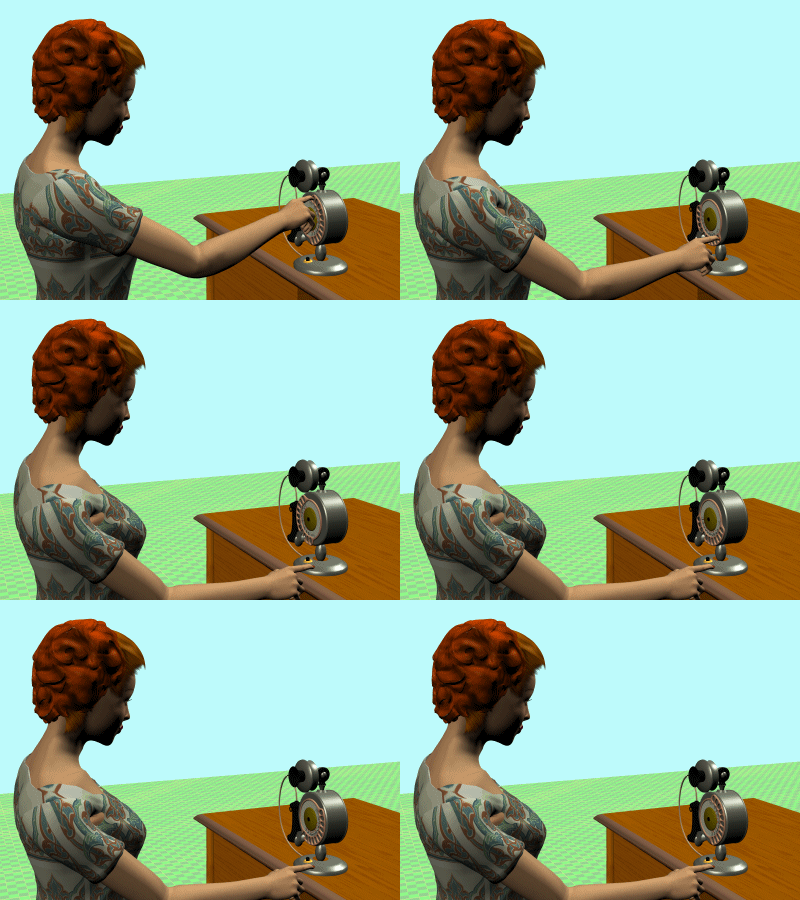
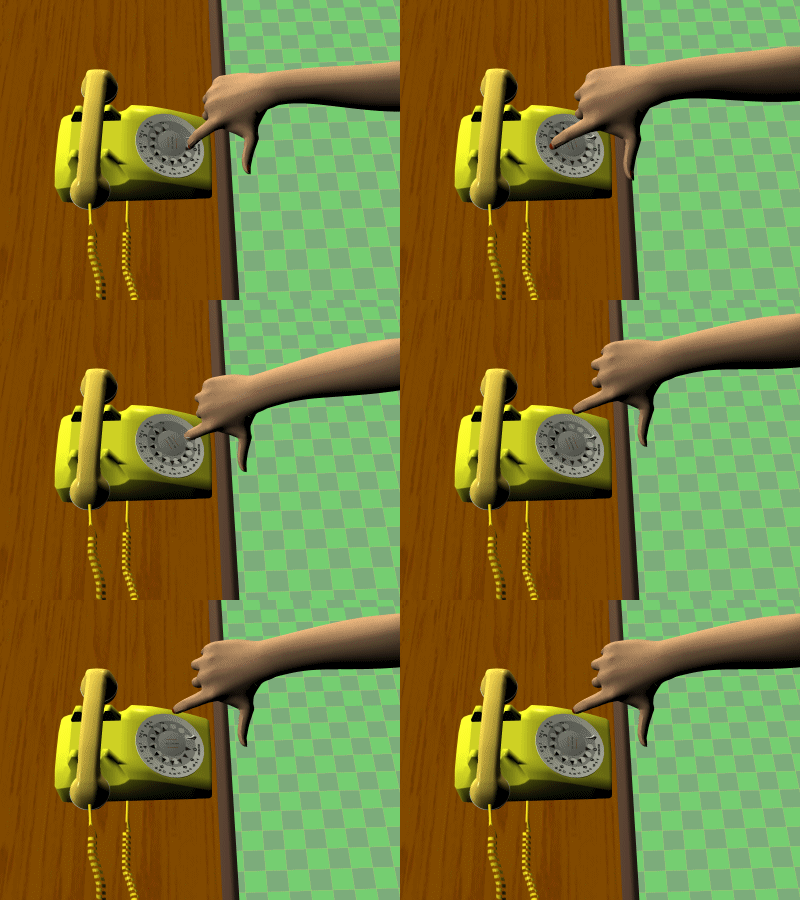
Strowger’s original dial was ergonomically better than Bell’s. For unknown reasons Bell chose a full circle instead of a half circle, which made dialing far more difficult.
========================================
With those six patterns in mind, the mismatch is clear. Google’s rotary keyboard is using Bell’s dial, a selecting mechanism, to send a signal.
==============================
Libraries are an entirely separate root stock for selecting but NOT for signaling. Instead of using a digit or letter to make the selection like an alphabetical file, libraries use a tree-like sequence of subject matter.
McBee cards were one mechanical implementation of subject-based branching selection:
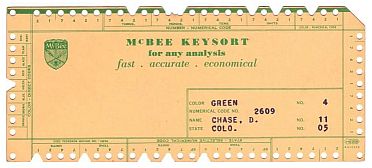
The surface of the web is library or McBee. (Down deep in the hardware it’s mostly post office and Strowger, but we don’t see those activities.)
Google itself is a subject selector, not an alphabetical or regional selector. Most platforms are also subject-based, with a set of descending tabs or levels for the subject areas included in the platform. A clothing shop selects by gender, type of clothing, size and color.
And finally the brain has distinct areas for subject matter. Here are the McBee notches responding to animals and plants:
 Polistra's Mill