
There’s no point in pretending that I have human readers, so might as well screw around and do some actual science. The originals of these two items, written in 2024, are Bot Attractors. The bots love to “read” them. I’ve replaced the text of the originals with frequency-typical random. We’ll see if they still get the same amount of “reads” now that they’re utterly meaningless to a human. The real original text is here now so I can still read it if I want.
=====================
The first practical wireless communication was 10 years before Marconi. In 1885 Lucius Phelps developed an induction-loop wireless system for moving trains. Granville Hicks did the same thing around the same time. Later, as always, Edison stole it and made it a bigger commercial success. But even Edison’s version isn’t featured in the usual histories of radio.
Oddly there were three separate Phelpses in telegraphy. Lucius Phelps developed the railroad induction loop. George Phelps was a big name, first as a mentor to Edison and later as the chief inventor for Western Union. George specialized in printers and ticker tapes. Later, William Pitt Phelps also patented printing telegraphs for Western Union. I’m guessing WP was George’s son, but George’s online bio doesn’t mention him.
Back to Lucius. The most important aspect of his system was the audio-frequency carrier, which presaged Marconi’s radio-frequency carrier. Phelps was thinking in terms of perceptual salience. Simple clicks weren’t enough in a decoupled arrangement. As a train roars along the track, the antenna will pick up plenty of clicks and pops from static discharges. Most tracks were paralleled by signal wires and an ordinary telegraph line to connect the stations, and the train’s antenna would pick up the clicks and pops from those wires. Salient communication needed to be tuned in some way, and Phelps settled on a buzzer in the transmitting side.
= = = = =
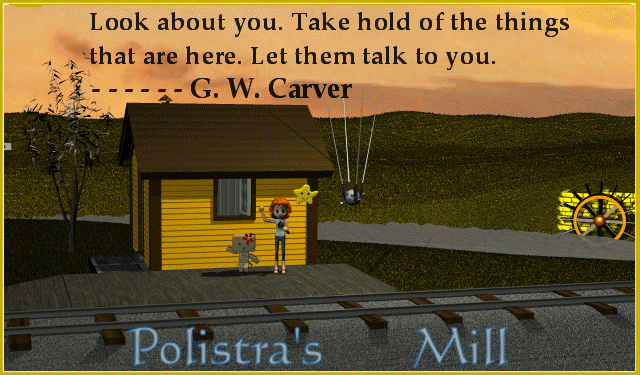
Here’s our familiar Mill station:

Inside the station, Polistra is sending to the caboose.

The Phelps setup includes the key, a buzzer, an induction coil, and the Phelps Relay. The buzzer and induction coil are involved in sending, and the Phelps Relay and earphone are the receiving side.

The station antenna is a long wire between the tracks, encased in a creosoted wooden conduit, common in early telegraphy.

Here’s an animation of how the buzzer triggers pulses in the long wire.

The switch closes, energizing the induction coil which sends a brief pulse through the antenna wire. The pulse fades, and then the switch opens, turning off the current and launching a brief magnetic pulse in the other direction. The outs and ins of the pulses are the real influencer to the car’s underwire.
= = = = =
Opening up the caboose we see another Phelps setup:

Under the caboose we see the car’s antenna, a long loop:

Inside the car, we see the Morse key on the left, the buzzer on the right, and the Phelps relay on top. Happystar is listening to the output of the Phelps relay.

The relay picked up the delicate back and forth currents from the induction loop when the station was sending, and flipped a contact back and forth to energize the earphone in a more or less sinusoidal way.

Continued in Part 2 with a parallel to Marconi’s setup.
 Polistra's Mill