
Somebody on substack recommended ‘A Field Guide to American Houses’ by McAlester. Recommended books are often disappointing but this one turned out to be splendid, just right for repeated browsing. It’s packed with actual lived-in houses, not architectural dreams.
The ‘field guide’ classifies all American houses, starting with the huts and tipis of the old tribes. The earliest styles are on the east coast as you’d expect. Examples of later styles are widespread, with a STRONG emphasis on KC, Wichita and OKC**. I’ve lived in those cities, so the neighborhoods are familiar though none of the specific houses ring a bell. I was hoping for more from St Joseph to help locate the mysterious Folly House. There are no pictures from St Joe, a famous time capsule of early 19th century architecture, especially what the book calls Italianate.
My own little house certainly wasn’t built with any particular style in mind; it was just a standardized tenant cottage. Surprisingly the book classifies this form as National Folk style, massed plan side gabled subtype. The author credits railroads for spreading the simple types.
The book shows this somewhat larger example in New Madrid, built in 1940.

It has a WPA or TVA flavor, though I don’t recognize it as one of the TVA houses I modeled.
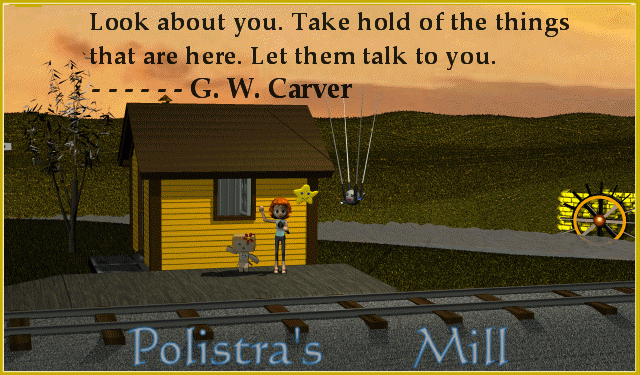
And here’s the digital version of my house:

The first owner in 1948 came from Missouri and worked for the railroad.
= = = = =
** The authors list hundreds of acknowledgements and photo credits in a preface. They give special credit to an associate in Wichita. This accounts for the Wichita emphasis, and probably KC and OKC as well. Both are easy drives on I-35.
= = = = =
Random 1: The book shows maps of colonial influence areas, mostly familiar. The area of French control left French houses, English control left English houses, Spanish gave us Spanish styles, Dutch gave us Dutch. Nonbark: Most of middle America is missing. Caucasians between the coasts are about half German and half Irish/Scotch. There isn’t a German Colognial or Scottish McMansion style. German cities looked similar to Dutch, but the immigrants didn’t copy them. Hermann, the most self-consciously German town, seems to have some Dutch-looking buildings but I suspect they’re ‘theme park’, not natural. Googling Scottish architecture gives ordinary English buildings.
Random 2: I’ve skimmed most of the pics and looked closely at a couple hundred. Half of the houses are in snowy places like New England or Chicago. I’ve only seen two pictures with snow on the ground. Both are in Louisville!
 Polistra's Mill