
First input, unquestionably true: Social media is THE OPPOSITE OF AN ECHO CHAMBER. Algorithms are designed with GREAT PRECISION to give you what you hate, not what you want. After you’ve seen an item, sometimes you think about it and want to go back and look again. YOU CAN’T GET THERE. The algorithm knows that you want to spend time on this subject, so this subject is no longer available.
Second input, seemingly true from secondhand info, without any actual experience: ChatGPT seems to act more like an echo chamber or a friendly guide. It grasps what you want and gives you more of it, while carefully guiding you into different channels if it wants you to go elsewhere.
Output: These opposite approaches have old human versions. Social algos act like fraudsters or false prophets, and ChatGPT acts like a normal salesman.
Fraudsters (including religious false prophets) induce a desire and then BLOCK the desire, so you’re FIERCELY DETERMINED to get there by ANY MEANS.
Normal salesmen or businesses show the product or service, then try to build an EASY PATH toward purchase. A good salesman senses when you are resisting, and builds a new path via a different view of the features or more friendliness or a lower price. There are many ways to build the path, and the best salesmen can shape the path creatively at every moment.
= = = = =
In engineering terms, swindlers are dams and honest salesmen are fields of grass. A dam builds up pressure until the gate is opened. A field absorbs water at every stem, using the water to form new stems. (See reprint below.)
= = = = =
Meta-output:
When normal business is unavailable or too expensive, swindlers and false prophets abound.
This situation arises in regular economics when stock traders create depressions to enrich stock traders, or when regulations written by stock traders force honest businesses to overcharge. Within the online arena the currency is attention instead of money but the rule still holds.
ChatGPT is especially popular right now because the usual social algos are TOO EXPENSIVE in emotional and attentional currency.
This imbalance should present a business opportunity for a social platform that acts like an honest business instead of a cult, but such creatures do not exist. Altman controls all.
= = = = = PARTIAL REPRINT on impedance:
Our thinking on these subjects is narrowed down by our intuitive sense that force is a positive PUSH acting on an object.
Life emphatically doesn’t agree. Life mostly moves things by changing impedance on two sides of a balance.
Nature moves water around by changing the impedance of the ground.
We had 3/4″ of rain yesterday from two separate storms. A gravel street in the neighborhood always gathers a huge puddle after a rain. The puddle stays for several days.
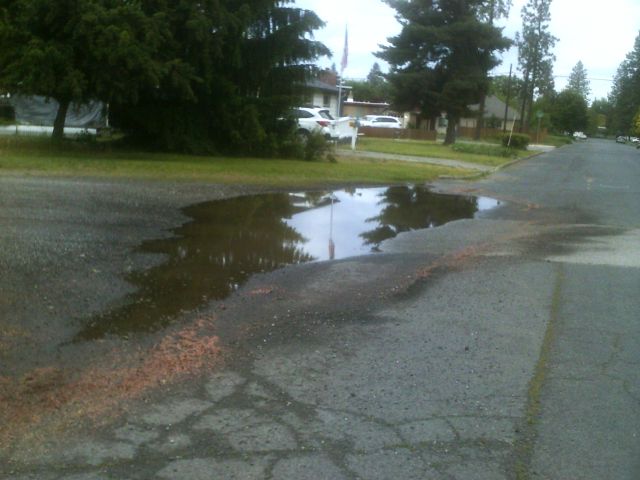
For comparison, here’s my “driveway”, which is just grass. It’s a similar low spot next to pavement. No puddle, and the pavement is dry.

Intuitively the gravel street should absorb water because there’s no cement under it. But it doesn’t absorb at all. Impedance, not force, is the key. Grass eagerly absorbs water. When water soaks down an inch deep, the roots pull it in immediately, making room for more soak from above. Where grass isn’t making room, the water soaks down an inch and stays there. All the available spaces are filled and incompressible. Nothing is actively emptying them.
= = = = =
In 2016 I snapped the newly built Pit in the boulevard. The Pit was raw dirt at that time, and the picture was taken after two storms totaling 3/4″.

I snapped the same pit today, after the same type of input. The pit now has well-established grass and trees, both joyously lapping up the water.

= = = = =
Soil conservation is all about managing impedance. The New Deal taught farmers how to use impedance to move water by contour plowing, and to move air by windbreaks. Windbreaks are an even more sophisticated use of impedance, altering the balance with reactance instead of resistance.
When the wind comes whistlin cross the plain, a line of trees can redistribute its energy. The air has to twist and turn between small leaves and branches. Part of the force is thus turned aside and spent in mechanically thrashing the leaves and branches, and part is spent in the whistlin.
Here a simplified windbreak is sheltering a farmhouse.

Seen from above, a straight wind encounters the windbreak. The air currents get tangled and twisted in an infinite number of small vortices (blue). The energy is still there; it hasn’t been converted to heat or anything else; but now it’s confused and incapable of breaking walls or lifting topsoil.

Real windbreaks were much denser than my simplified pair of trees. The CCC planted windbreaks all over the Plains, often using the tough and flexible Osage Orange or bois d’arc tree.
= = = = =
A universally familiar example of moving by impedance is breathing. When we want air, we don’t insert a pump into the nose and push air inward. We expand the lungs, making more room between the molecules inside, and the outside air flows in to equalize the impedance.
In the other direction, the larynx is a windbreak. It transforms the steady outward movement of an exhale (which IS a push) into vortexes that decrease the outward velocity. Try speaking a sentence with lots of sibilants, or just sing the Lawyer’s Song: Sue sue sue sue sue! Hold your hand in front of your mouth and you’ll detect the difference in force between the windbreaked voice and the unpulsed sibilants.
Complex mechanical and electrical systems move fluids by decreasing the pressure on one side. When you open a faucet, the water in the pipe senses the lower pressure on the air side and flows to equalize the balance. When a transistor opens its gate, electrons flow through to the opposite side which has been intentionally deprived of electrons.
 Polistra's Mill